
Through the Looking Glass: The Process.
Independant Research Project at RCA (Sole Designer)
Project Overview:
This page documents the design process behind Through the Looking Glass, focusing on how perceptual distortion was translated into a spatial, interactive system in VR.
Instead of simulating impaired vision, the project treats instability, fluctuation, and partial clarity as core interaction principles, shaped through rules, constraints, and feedback.
Tools:
Unreal Engine,
Blender,
Meta Quest,
Motion Capture,
Sound Design
Timeline:
September 2024 - May 2025
The work is informed by embodied experimentation and iterative prototyping, creating a world where perception responds to movement, attention, and proximity.
Design Question -
How can perceptual distortion be translated into a spatial, interactive system without reducing it to simulation or spectacle?
This project began with a need to design for uncertainty rather than clarity, and for emotional truth rather than visual accuracy.
Conceptual Foundation.
The experience draws from:
-
lived experience of progressive vision loss
-
medical understanding of keratoconus
-
philosophical perspectives on perception and awareness
Rather than recreating vision loss literally, the system focuses on how distortion feels to inhabit over time.

Mapping my lived experience of keratoconus, from perceptual changes to emotional and conceptual shifts.

Age distribution of participants and age at first keratoconus diagnosis, highlighting early onset.

Qualitative responses capturing the emotional impact of keratoconus across diagnosis, treatment, and daily life.

Survey data showing common visual disturbances and treatment paths experienced by people with keratoconus.
Perceptual System.
The world operates on a set of perceptual rules:
-
distortion is dynamic, not static
-
clarity is temporary and contextual
-
focus is influenced by movement, proximity, and attention
Visual instability is treated as a living condition of the space, not a visual effect layered on top.
How the spaces were planned and translated into storyboards, shaping their final form in the VR experience -
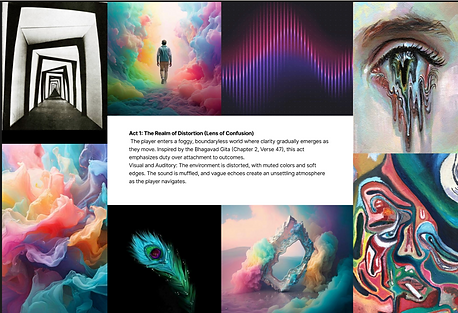

Moodboard → Storyboard → VR Space


Moodboard → Storyboard → VR Space
A visual progression from emotional intent to spatial experience.
Spatial Structure.
The experience is divided into sequential spatial phases that mirror emotional progression:
Phase 1: Illusory Clarity
The environment appears stable at first, slowly introducing visual inconsistencies that are easy to ignore.
the blues start to dance into a blur.

-
Stable geometry with subtle depth inconsistencies.
-
Gradual edge blur introduced over time, not movement.
-
Colour and light designed to evoke familiarity and safety.
-
Distortion designed to remain ignorable at first.
Phase 2: Clinical Disorientation
Distortion increases and familiar spatial cues begin to feel unreliable, creating emotional unease.
like a reality leaking

-
Familiar clinical geometry rendered spatially unreliable.
-
Floating elements used to break gravitational logic.
-
Subtle misalignment to create persistent unease.
-
Surreal shifts introduced without overt visual chaos.
Phase 3: Forced Stillness (C3PR Surgery)
Movement is removed entirely, shifting attention away from navigation and toward internal sensation.
I sink into black, with nothing to sense

-
Light treated as the primary spatial material.
-
Constrained interaction to enforce stillness.
-
High contrast and intensity to overwhelm perception.
-
Time deliberately slowed to heighten bodily awareness.
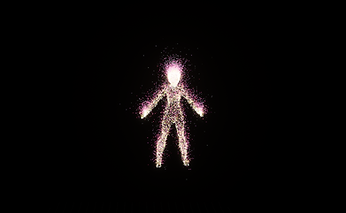
Phase 4: Dissolution and Becoming
Perception becomes unstable and layered, resisting interpretation or correction.
making everything unfamiliar
-
Fragmented human form used as a spatial anchor.
-
Use particle systems to evoke continuous transformation.
-
Cycles of formation and dissolution built into the space.
-
Environmental detail reduced to direct focus inward.
*Made via Motion Capture.
Phase 5: Reclaimed Presence
The experience settles without full clarity, allowing awareness to replace resolution.
where the blue skies are no longer my limits

-
Open, non-linear spatial structure.
-
Colour and motion prioritised over sharp form.
-
Simple creative interaction introduced as agency.
-
Distortion reframed as coexistence rather than threat.
Interaction Logic
Interaction is intentionally minimal and embodied:
-
movement alters perception
-
stillness allows partial stabilization
-
proximity reveals detail while obscuring context
The system avoids gamified feedback.
Instead, it rewards patience and adaptation.
Key Design Decisions.
1. Allowing freedom, then deliberately removing it
Early participants explored the space freely, attempting to orient themselves and regain visual control.
A later phase intentionally removed movement altogether, forcing perception to shift inward rather than spatially.
This contrast made stillness feel purposeful rather than restrictive, redirecting attention toward emotional awareness.
2. Designing interaction without instruction
Participants instinctively reached for and interacted with objects without guidance.
Interactions were kept implicit, relying on proximity and curiosity rather than explicit prompts or goals.
This preserved a sense of discovery and prevented the experience from becoming task-driven.
3. Using sound to guide emotion, not narrative
Visual distortion alone sometimes led participants to focus on understanding the environment.
Environmental and emotional sound layers were introduced without narration or explanation.
Sound became an emotional anchor, supporting awareness without resolving the experience.

Participant inside the VR experience during the distortion phase.

Embodied Responses.
Participants engaged with the experience physically and emotionally, often slowing their movement, becoming still, or hesitating before interacting.
The work was designed to be felt through posture, pace, and attention rather than instruction or explanation.
Friction & Learning.
Early versions overwhelmed participants visually.
Reducing visual noise and shifting emphasis toward sound and pacing created a more grounded and emotionally legible experience.
Outcome.
This project reshaped how I think about accessibility, immersion, and empathy in spatial design.
It reinforced the idea that clarity is not always the goal, and that design can hold space for ambiguity without needing to resolve it.
Recording of the full VR experience.