
Order and Chaos: A material and symbolic exploration of order, chaos, and cultural becoming.
Project, Srishti Institute of Art, Design and Technology (Sole Designer)
Project Overview:
Bleeding Birth is a large-scale acrylic painting with projection mapping, exploring the moment where order and chaos collapse into one another.
Rooted in myth and semiotics, the work treats instability as the ground from which new meaning emerges.
Tools:
Timeline:
Acrylic on Canvas,
Projection Mapping,
TouchDesigner,
Text and Poem Integration
3 months
The project integrates physical media with projection technology, animation logic, spatial experience, and symbolic meaning.
What happens when order and chaos stop opposing each other and begin to coexist?
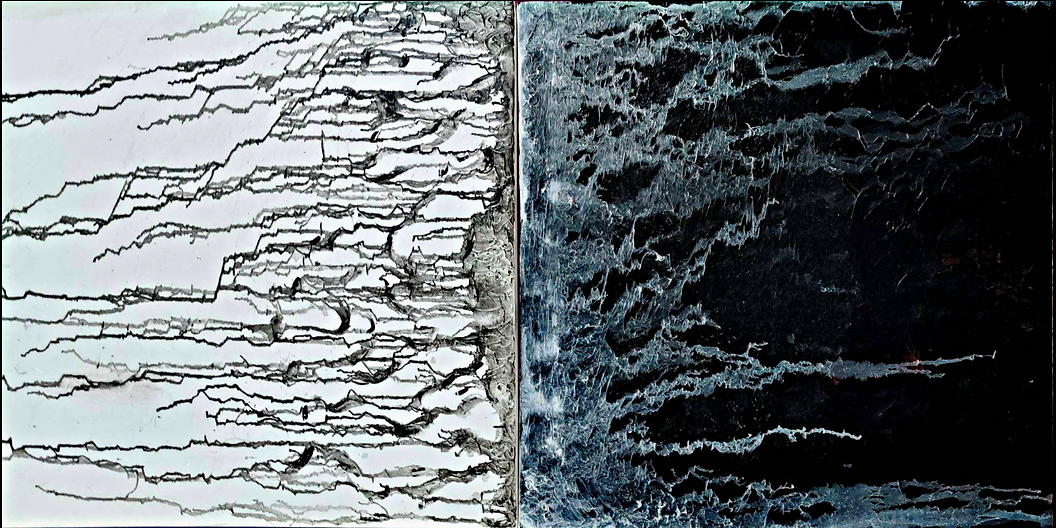
Bleeding Birth is a large-scale acrylic painting activated through projection mapping, exploring the moment where order and chaos collapse into one another.
Rooted in myth, semiotics, and cultural theory, the work frames order and chaos not as opposites, but as interdependent forces that continuously destroy and regenerate each other. Rather than presenting balance or resolution, the piece holds viewers inside the instability where new forms of meaning begin to emerge.
Conceptual Grounding
Across ancient creation myths, chaos is not something to be eliminated but the condition from which order emerges.
Narratives such as Horus, born from disorder to restore balance, and the Enuma Elish, where the world is formed from the body of chaos itself, echo ideas found in Hindu philosophy, where creation, dissolution, and renewal exist in continuous cycles.
Concepts such as pralaya (dissolution) and samsara frame chaos not as failure, but as a necessary phase of becoming.
Bleeding Birth treats this cycle as internal to human consciousness, positioning culture as a fragile negotiation between stability, entropy, and renewal.
Key Design Decisions.
1. Collapsing the project into a single moment
Rather than showing a progression of stages, the work was reduced to one decisive state: the instant where order and chaos bleed into each other.
This concentrated the experience, allowing viewers to confront transformation directly rather than narratively.
2. Letting material breakdown carry meaning
Hard edges and structured forms were intentionally disrupted through bleeding acrylic and surface irregularities.
Material failure became a symbolic language for cultural fragility and change.
3. Introducing motion only through projection
Projection mapping was added exclusively to animate the breakdown, not the structure.
This ensured movement functioned as transformation rather than embellishment, reinforcing the idea that new order emerges only through instability.
The work.
Bleeding Birth resists resolution.
Rather than offering clarity or balance, the work invites viewers to remain inside uncertainty and recognise transformation as an ongoing state rather than a final outcome.
The piece exists as a single large-format canvas, painted in black and white acrylic.
Rigid forms suggest systems, rules, and cultural order. These boundaries are deliberately disrupted, allowing pigment to bleed, merge, and fracture. Projection mapping is layered onto the surface, introducing motion only at the point where structure collapses.
The work does not depict creation as a clean beginning, but as a messy, unstable emergence.
Updating Soon...
Recording of the full experience.
Acrylic on canvas.
160 cm x 80 cm.
Symbol, Language, and Meaning.
The work treats symbols as the base language of human consciousness.
Black and white, stillness and motion, containment and bleed operate as pre-linguistic signs that precede spoken language. Language is understood as a secondary system that regulates meaning but evolves alongside symbolic change.
As symbols fracture, so do the structures that depend on them.